Your classroom may be ready, but is it ready for every child who walks through the door?
By the first day of school, most teachers have spent countless hours arranging desks, hanging bulletin boards, labeling bins, and organizing classroom libraries. We carefully plan procedures, establish routines, and prepare lessons. These are all important steps toward creating an effective learning environment.
But before we can truly teach students, we must first know them.
Creating an inclusive classroom is about far more than decorating with diverse images or stocking a classroom library with books featuring children from different backgrounds. While representation matters, culturally responsive teaching asks us to go deeper. It challenges us to intentionally build a classroom where every student’s culture, language, experiences, and ways of knowing are recognized as strengths that enrich learning for everyone.
Students should not have to leave parts of themselves at the classroom door.
It Begins with Reflection
Before learning about our students, we should spend time reflecting on ourselves.
Each of us brings our own experiences, assumptions, and perspectives into the classroom. These perspectives shape how we interpret behavior, recognize participation, define “appropriate” communication, and determine what we view as engagement.
Reflecting on our own perspectives isn’t about assigning blame or feeling guilty. It’s about becoming more intentional. When we challenge “color blindness” and recognize that we all have implicit biases, we can begin making instructional decisions based on curiosity rather than assumptions.
I’ll explore implicit bias more deeply in a future post because it is foundational to creating equitable learning environments.
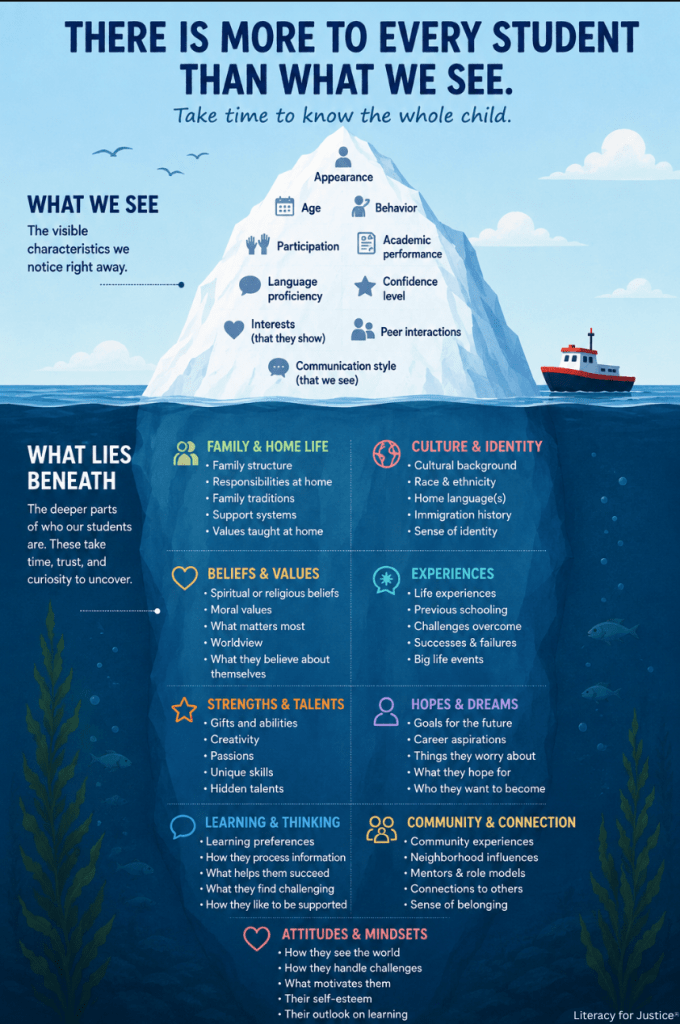
Students Are Like Icebergs
When we first meet our students, we naturally notice what is visible above the surface. We might observe their appearance, personality, participation, academic skills, or behavior during the first few days of school. While these observations provide valuable information, they represent only a small part of who each child is.
Like an iceberg, most of what makes a student who they are lies beneath the surface.
Hidden from immediate view are their family traditions, cultural values, home language, community experiences, interests, talents, fears, responsibilities, aspirations, previous school experiences, and personal challenges. Beneath the surface are also the strengths they have developed through those experiences – strengths that may not appear on a benchmark assessment or during the first week of school.
When we make assumptions based only on what we can see, we risk misunderstanding our students. But when we approach each child with curiosity rather than assumptions, we begin to uncover the rich knowledge and experiences they bring into our classrooms.
Culturally responsive teaching begins by recognizing that every student arrives with assets worth discovering. Our role is not to “fill” empty vessels with knowledge, but to build meaningful learning experiences that connect with what students already know, value, and bring to the classroom.
As teachers, we should ask ourselves not only, “What do I see?” but also, “What haven’t I learned about this student yet?”
You can download the free LFJ asset-based student survey here: https://payhip.com/b/tTZkM
Every Child Brings Assets to the Classroom
Every student enters your classroom with valuable knowledge and experiences.
Some speak multiple languages.
Some have deep knowledge of family traditions or community history.
Some are natural storytellers.
Some solve problems in creative ways.
Some have responsibilities at home that have developed remarkable resilience.
When we view these experiences as assets rather than obstacles, we begin designing instruction that builds on what students already know rather than focusing on what they lack.
What Does This Look Like?
Getting to know students should be intentional…not left to chance.
Some practical ways include:
- Learning and correctly pronouncing every student’s name.
- Asking students how they prefer to be addressed.
- Using beginning-of-the-year interest and identity surveys.
- Talking with families early in the year.
- Learning about students’ hobbies, interests, and passions.
- Discovering what students enjoy reading and what they avoid.
- Encouraging students to share their perspectives during class discussions.
- Connecting examples and learning activities to students’ lived experiences.
- Creating opportunities for students to see themselves reflected throughout the curriculum, not only during heritage or awareness months.
Questions Worth Asking
As you begin this school year, ask yourself:
- What do I know about my students beyond their academic data?
- Whose voices are represented most often in my classroom?
- Whose voices might unintentionally be missing?
- How can I build on students’ strengths during instruction?
- Would every student say they feel like this classroom belongs to them?
These questions don’t have perfect answers. Their purpose is to keep us growing.
An Invitation
This week, challenge yourself to learn one meaningful thing about every student that won’t appear in a cumulative folder.
You may discover a future scientist who loves drawing.
A reluctant reader who tells incredible stories.
A bilingual student who becomes a bridge between classmates.
A child whose quietness reflects thoughtfulness rather than disengagement.
When students feel known, they are more likely to feel safe. When they feel safe, they are more willing to participate. And when they see themselves reflected and valued in learning, they are more likely to develop confidence not only as students, but as readers, writers, thinkers, and members of your classroom community.
Because the goal isn’t simply to create a classroom where every student fits in.
It’s to create a classroom where every student belongs.
We’d love to hear from you!
What’s something you do to create an inclusive classroom? Share it in the comments!
Follow us on Facebook!


Leave a Reply