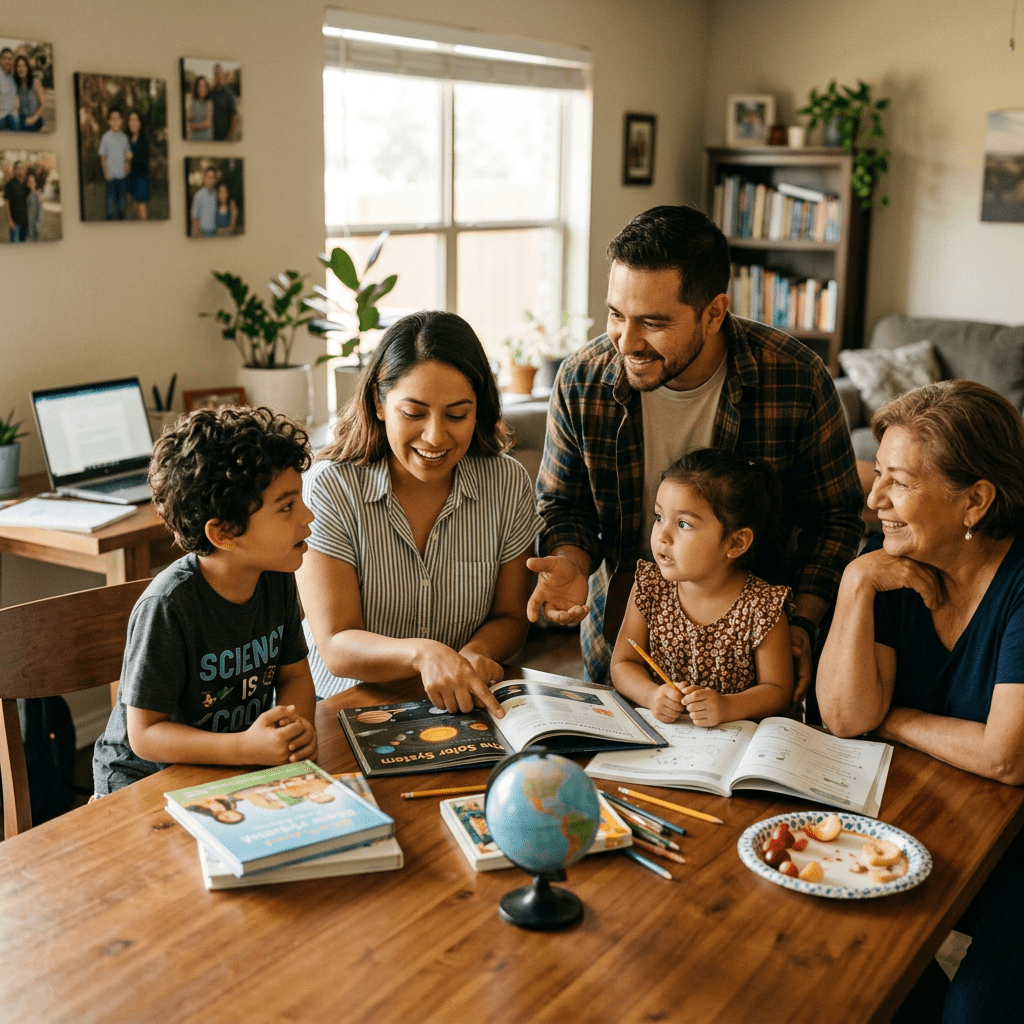
How to Improve Your Child’s Oral Language Development
Have you ever learned a new word during an everyday conversation?
I was listening to a podcast recently, and the guest speaker was talking about a dishwasher and mentioned a utensil caddy. I instantly knew exactly what they were describing, but I had never heard that term before. In my house, it was always just “the basket that holds the utensils.”
That simple moment reminded me that oral language development doesn’t end when we become adults. Every conversation introduces us to new vocabulary, new ways of expressing ideas, and new ways of understanding the world.
The difference is that children experience these moments hundreds of times a day, and those interactions are laying the foundation for reading, writing, and speaking.
What is oral language?
Oral language is much more than talking.
It includes the ability to:
- Listen and understand what others say
- Express ideas clearly
- Learn and use new vocabulary
- Participate in conversations
- Ask and answer questions
- Tell stories
- Explain thinking
- Understand the meanings of words and sentences
Long before children recognize letters or read books independently, they are developing these language skills through everyday conversations with parents, siblings, grandparents, caregivers, teachers, and friends.
Why does oral language matter?
Research consistently shows that strong oral language skills support later reading comprehension and academic success (National Early Literacy Panel, 2008; Snow, 2002). Children who hear rich vocabulary and engage in meaningful conversations build the background knowledge and language they will eventually use to understand what they read.
Think about it this way: A child may be able to sound out the word volcano, but if they’ve never heard the word before or talked about volcanoes, reading it won’t automatically lead to understanding.
Language gives meaning to print.
Simple ways to build oral language at home
The good news is that you don’t need expensive materials or structured lessons.
Some of the best opportunities happen naturally throughout the day.
- Have real conversations instead of only asking yes/no questions.
- Introduce new vocabulary during everyday routines. (“Let’s put the silverware in the utensil caddy.”)
- Narrate everyday actions. Even before children begin talking, describe what you’re doing throughout the day. (“Let’s open the door. Open. Now let’s close the door. Close.”) Those simple moments expose children to vocabulary in meaningful contexts.
- Read aloud together and pause to talk about the story.
- Encourage your child to explain their thinking rather than simply giving an answer.
- Tell stories about your own childhood and invite your child to share experiences.
- Sing songs, recite nursery rhymes, and play with words.
- Give children time to respond instead of answering for them.
- Expand on what your child says. If they say, “The dog is big,” you might respond, “Yes! That’s a gigantic dog. He looks enormous!”
These everyday interactions expose children to richer language in meaningful contexts, making new vocabulary easier to understand and remember (NAEYC, n.d.).
Every language experience matters.
One thing I always remind future teachers is that children don’t come to school without language—they come with various language and life experiences.
Whether conversations happen in English, Spanish, American Sign Language (ASL), or another language, every language a child speaks contributes to their communication and learning. The same is true for regional dialects and community language practices. These are not obstacles to overcome; they are strengths that children bring with them.
As educators and families, our goal isn’t to replace a child’s home language or dialect. It’s to build upon the rich language experiences they already have while helping them learn additional ways to communicate across different settings.
Language is an asset, and every conversation helps it grow.
It’s never too late.
One of my favorite things about language is that none of us ever finishes learning it. Whether you’re two years old or sixty-two, conversations continue to grow your vocabulary.
Maybe it’s hearing someone say utensil caddy for the first time.
Maybe it’s learning a new phrase from a coworker, a podcast, or a friend.
Every conversation has the potential to teach us something new.
So don’t underestimate the power of talking with your children, or with each other. Language grows through connection, and every conversation is an opportunity to learn.
Looking for more ways to support your child’s language development? Read my posts on educational toys that encourage conversation and balanced screen time for young children.
- Is Screen Time Really the Enemy?
- Beyond the Screen: Educational Toys That Encourage Real Learning Through Play
I’d love to hear from you! What’s a word or phrase you learned as an adult that you now find yourself using all the time? Share it in the comments!
References
National Association for the Education of Young Children. (n.d.). Everyday steps to reading and writing. https://www.naeyc.org/our-work/families/everyday-steps-reading-and-writing
National Early Literacy Panel. (2008). Developing early literacy: Report of the National Early Literacy Panel. National Institute for Literacy. https://lincs.ed.gov/publications/pdf/NELPReport09.pdf
Snow, C. E. (2002). Reading for understanding: Toward an R&D program in reading comprehension. RAND Corporation. https://www.rand.org/pubs/monograph_reports/MR1465.html
Follow us on Facebook!


Leave a Reply