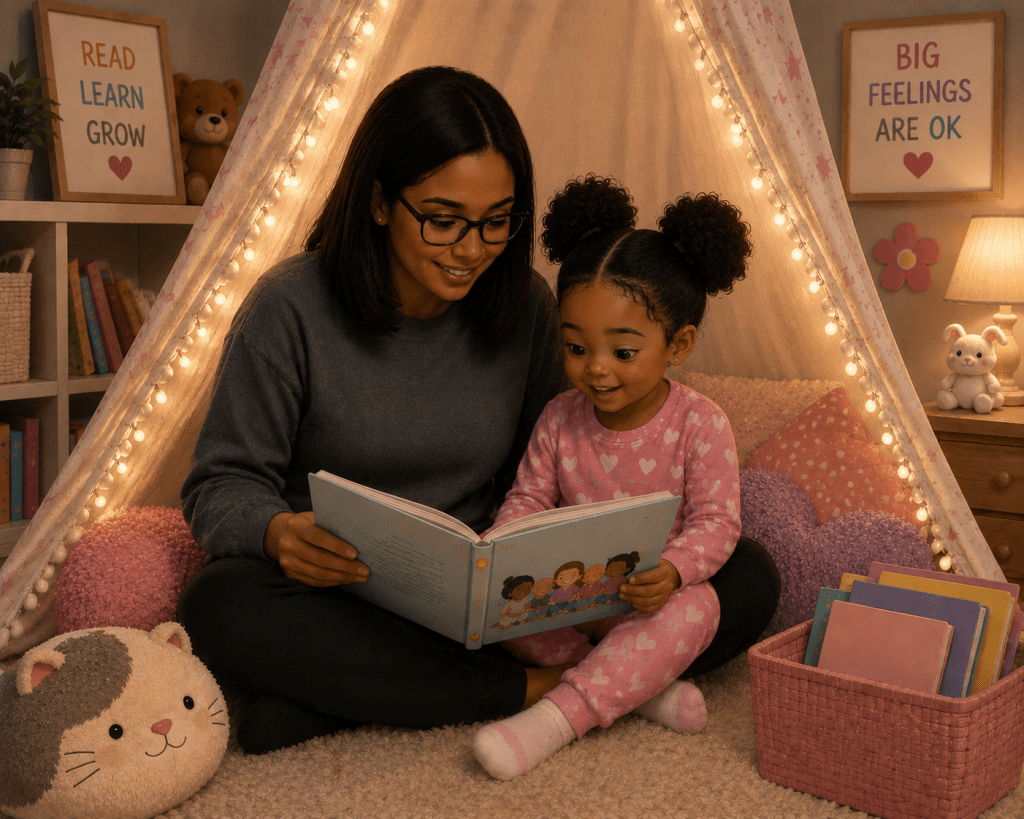
It has been a busy few months! Between teaching, research, service commitments, and motherhood, Literacy for Justice has been quieter than usual. Yet some of the most rewarding literacy learning I have experienced recently has not occurred in a classroom, at a conference, or in a research study. Instead, it has happened in my daughter’s cozy reading tent as we read together.
As a literacy researcher, teacher educator, and mother, I have spent years studying how children learn to read. I have read the research, taught future teachers, and worked with students across grade levels. Still, watching my daughter develop as a reader has reminded me of something important: reading development begins long before children can independently decode words on a page.
In education, we often focus on what children can do. Can they identify letters? Can they produce letter sounds? Can they blend phonemes? Can they read a book independently? While these skills are important, they are only part of the story. Before children become readers, they learn to connect.
Recently, I have watched my daughter request the same books night after night. She points to familiar words, notices letters in the environment, and “reads” favorite books from memory. I ask questions about what is happening in the stories, she giggles at the characters’ actions, and we eagerly relate stories to her own life experiences. These moments may seem small, but they represent significant literacy development.
Researchers refer to these early behaviors as emergent literacy. Emergent literacy includes the skills, knowledge, and attitudes children develop before conventional reading and writing (Whitehurst & Lonigan, 1998). Long before children read independently, they are learning how books work, how stories are structured, and how language communicates meaning. Through shared reading experiences, children develop oral language, vocabulary, print awareness, and comprehension skills that provide a foundation for later reading success.
One lesson my daughter continues to teach me is that reading is relational. Some of our most meaningful conversations happen while reading together or when we reflect on books we’ve read together. We talk about characters, discuss feelings, act out story events, and connect stories to our daily lives. Research consistently demonstrates that these interactions are important. Shared reading experiences support language development, vocabulary growth, and comprehension while also strengthening relationships between children and caregivers (Mol et al., 2008).
As educators, we sometimes become so focused on instructional strategies that we forget literacy is fundamentally social. Children learn language through interaction. They learn to love books through positive experiences. They learn that reading matters when they see reading valued by the people around them.
Perhaps the greatest lesson I have learned recently is the importance of connections.
“Making connections” is a common phrase in literacy instruction, but watching my daughter has reminded me why it really matters. Before children learn to read independently, they learn to make meaning, and making meaning depends on connections.
Children connect stories to their own experiences. They connect characters to emotions they have felt. They connect new vocabulary to concepts they already understand. They connect ideas across books and conversations. These connections help children construct meaning and develop deeper comprehension.
One of my favorite parts of reading with my daughter is how books help us talk about big feelings, kindness, and making the right choices. Like many toddlers, she experiences strong emotions and is still learning how to manage them. Through stories, we explore how characters respond when they feel frustrated, disappointed, excited, or upset, and we practice strategies to calm our bodies and minds. Books also provide opportunities to discuss what it means to be kind, empathetic, and respectful toward others, helping her make connections between the stories we read and her everyday experiences.
While it can be exciting to celebrate milestones, our goal should not simply be to help children read earlier. Our goal should be to help children develop meaningful relationships with books, language, and learning.
Read together. Reread favorite books. Ask questions. Listen to children’s ideas. Encourage conversations. Make room for curiosity and wonder. These simple practices support literacy development while also creating opportunities for connection.
As I watch my daughter grow as a reader, I am reminded that literacy is about far more than letters, sounds, and words. Literacy grows through relationships, conversations, experiences, and connections. Long before children read independently, they build the foundation for lifelong literacy through impactful interactions with others.
Sometimes, the most powerful reminders about teaching, learning, and connecting come from our children sitting right next to us.
References
Mol, S. E., Bus, A. G., de Jong, M. T., & Smeets, D. J. H. (2008). Added value of dialogic parent–child book readings: A meta-analysis. Early Education and Development, 19(1), 7–26. https://doi.org/10.1080/10409280701838603
Whitehurst, G. J., & Lonigan, C. J. (1998). Child development and emergent literacy. Child Development, 69(3), 848–872. https://doi.org/10.1111/j.1467-8624.1998.tb06247.x
Follow us on Facebook!

 Literacy for Justice
Leave a comment