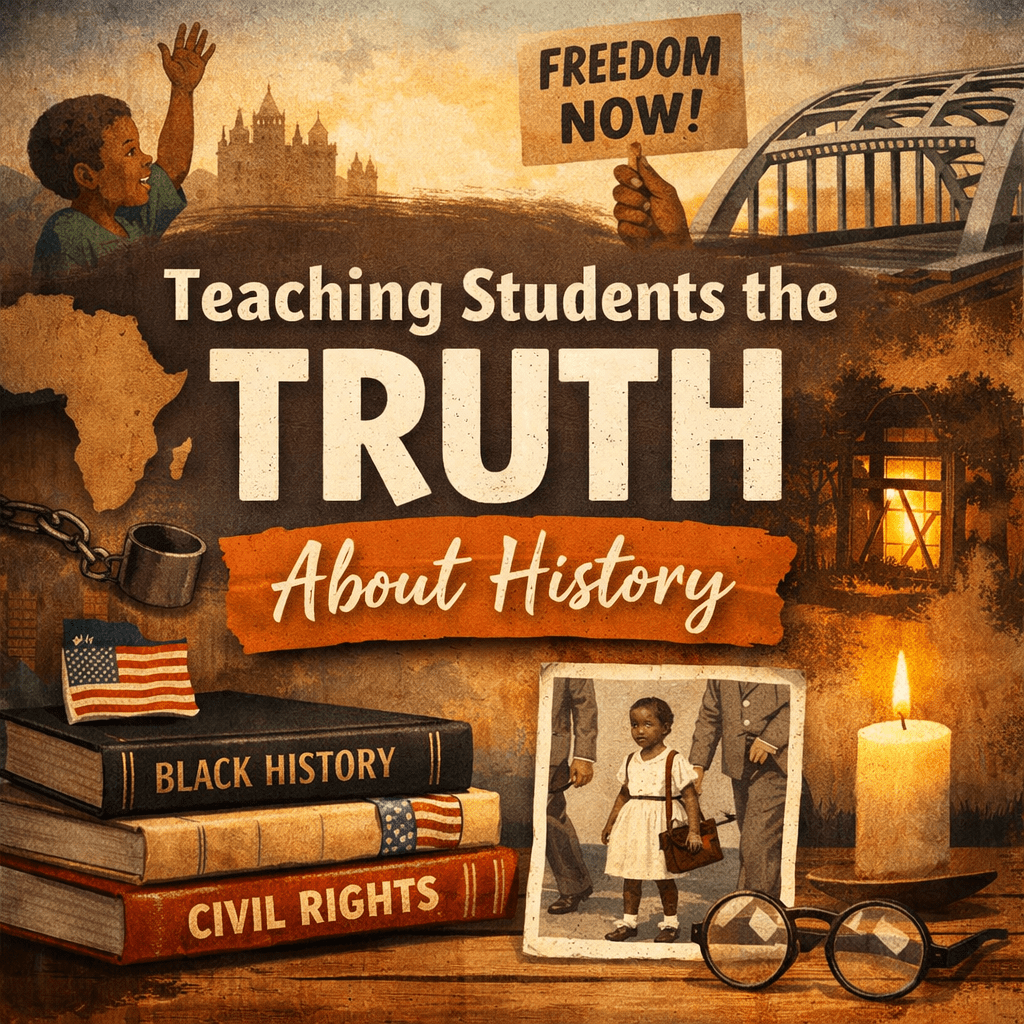
Teaching Students History With the Facts, Not Fear
Recently, a pre-service teacher asked a question in class about teaching sensitive history topics. She asked how to water down these topics during instruction. Without hesitation, both her classmates and I responded the same way: you don’t water it down. You give students the facts. You tell the truth in ways that are developmentally appropriate, but you never distort it, erase it, or soften it to protect adults’ “comfort”.
Children are far more capable than we give them credit for. They can understand fairness, injustice, courage, and resistance long before they can name complex political systems. What confuses and harms children is not the truth, but it’s the silence, avoidance, and half-stories. When we remove the “ugly” parts of history, we aren’t protecting our students; we’re protecting systems that were never built for them in the first place (and many of us know exactly which students that includes). Honest history doesn’t create harm—dishonesty does.
Children’s literature is one of the most powerful tools we have to teach truthful history with care. Well-written children’s books do not lie to kids; they contextualize truth through story, humanity, and voice. They allow students to see real people, real struggles, and real resilience. Not as abstract events, but as lived experiences. Through books, children learn that Black history is not just pain, but brilliance, resistance, and legacy.
At a time when there is growing pressure to remove certain histories from the curriculum under the guise of neutrality or fear-based rhetoric, we have to be clear: history does not become less true because it is uncomfortable. And while many educators want to teach honestly, they are navigating constraints such as district policies, legislation, parental pressure, and professional risk. That tension is real, and it deserves acknowledgment, not judgment.
This is why Literacy for Justice exists. To affirm educators. To support families. And to ensure children still have access to truths, even when systems make it difficult.
Stay tuned for a three-part Black History Month series:
- Children’s books that teach Black history truthfully
- Supporting educators teaching within real constraints
- Empowering families to fill the gaps with intention
Truth matters. And our children deserve it.
We want to hear from you!
What history did you have to unlearn as an adult, and what would it have meant to learn it honestly as a child?
Follow us on Facebook!
 Literacy for Justice
Leave a comment