At Literacy for Justice, we believe every child deserves to see themselves, learn about others, and step into new possibilities through the books they read. This is why Dr. Rudine Sims Bishop’s powerful framework—mirrors, windows, and sliding glass doors—is still essential today.
✨ Mirrors allow children to see their own lives, cultures, families, and identities reflected in stories.
✨ Windows let them look into the lived experiences of others, developing empathy and understanding.
✨ Sliding glass doors help them step through these stories, imagining new futures and ways of being.
Here’s why this matters now more than ever:
What the Data Tells Us
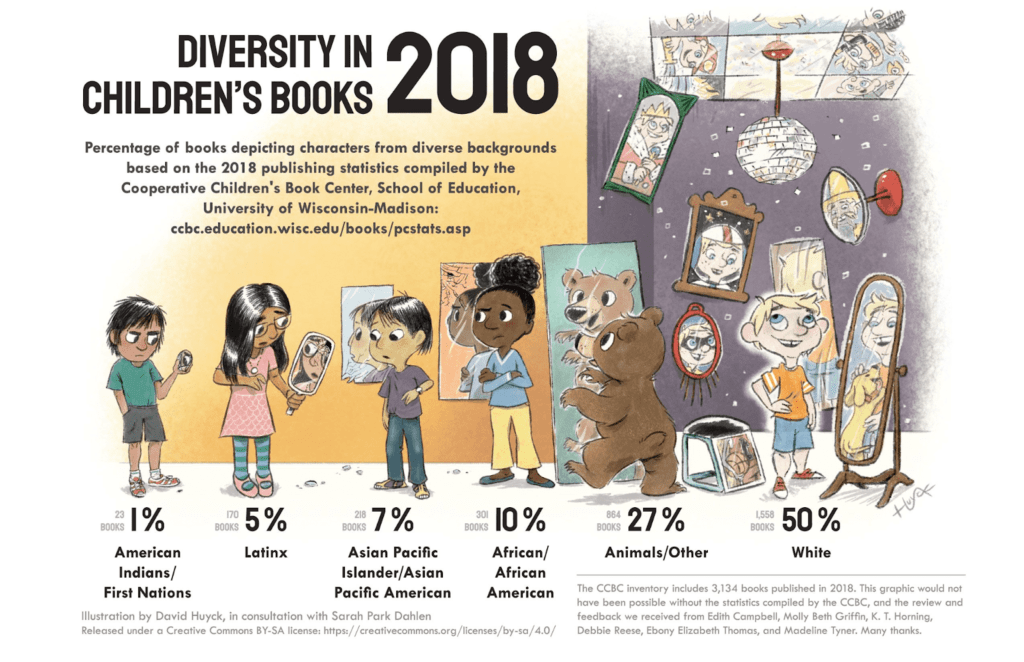
For decades, children’s books overwhelmingly centered white characters, even though classrooms were becoming more diverse. According to a Cooperative Children’s Book Center (CCBC) report:
- In 2014, only 11% of children’s books featured Black, Latinx, Asian, Indigenous, or other nonwhite characters.
- In 2018, that number rose to about 29%, but over 50% of all characters were still white or nonhuman animals and creatures.
Thanks to the voices of educators, parents, and advocates, representation in children’s literature has improved. In 2024, roughly 40% of children’s books included racially diverse characters. Yet, more than 40% of main characters are still white, and animals continue to appear in books at higher rates than many cultural groups.
According to the Kids Count Data Center, in 2024, 52% of the U.S. child population were identified as non-white alone. While children’s books still do not reflect the full diversity of today’s classrooms and communities, we are hopeful that representation in children’s books will continue to grow.
Why This Matters for Diverse Students
Representation isn’t “nice to have”—it shapes identity, confidence, belonging, and academic motivation.
When children of color, multilingual learners, and students from historically marginalized communities see themselves in stories, they:
- Feel affirmed and valued
- Develop stronger reading engagement
- Build identity and confidence
- See their cultures treated with dignity
Tips For Parents
1. Build a diverse home library.
Choose books with Black, Latinx, Indigenous, Asian, Muslim, and disabled, characters as main characters, not background extras.
2. Ask questions that deepen identity and understanding.
- “Does this character remind you of anyone in our family or community?” (Mirror)
- “What’s something new you learned about another culture?” (Window)
- “What would you do in this situation?” (Sliding door)
3. Look for authenticity.
Seek stories written by people from the communities represented.
Tips For Teachers
1. Audit your classroom library.
Aim for at least 40–50% of your books to feature racially or culturally diverse main characters.
2. Use both mirrors and windows intentionally.
Don’t only give students books “about their culture.”
Give them both identity mirrors and windows into others’ experiences.
3. Pair books with discussions and writing tasks.
- Identity journals
- Character comparison charts
- Perspective-taking activities
4. Make representation a routine, not a theme.
Diverse books should appear all year, not only during heritage months, like Black History Month.
We remain committed to uplifting inclusive stories. When all children read diverse stories, they grow into adults who value equity, humanity, and community.
Diverse books aren’t political, they are powerful tools for belonging and celebration. And every child deserves them.
We want to hear from you! Did you have access to “mirror” books growing up—stories where you truly saw yourself? What was your favorite book?
Click here to follow us on Facebook!
Sources:
- Annie E. Casey Foundation. (2025, September). Child population by race and ethnicity in United States. KIDS COUNT Data Center. https://datacenter.aecf.org/data/tables/103-child-population-by-race-and-ethnicity#detailed/1/any/false/1096,2545,1095,2048,574,1729,37,871,870,573/72,66,67,8367,69,70,71,12/423,424
- Bishop, R. S. (1990). Mirrors, windows, and sliding glass doors. Perspectives: Choosing and Using Books for the Classroom, 6(3), ix–xi.
- Cooperative Children’s Book Center. (2025, March 21). Books by and/or about Black, Indigenous and People of Color (All Years). University of Wisconsin–Madison. https://ccbc.education.wisc.edu/literature-resources/ccbc-diversity-statistics/books-by-about-poc-fnn/
 Literacy for Justice
Leave a comment