There’s a New Definition for Dyslexia—What Does This Mean for Teachers, Parents, and Students?
In October 2025, the International Dyslexia Association (IDA) released a brand-new definition of dyslexia—its first major update in over twenty years. The new wording was developed by a team of researchers, practitioners, and community members, and was presented at IDA’s 2025 conference.
You can view the full public presentation here: IDA Definition of Dyslexia 2025 Presentation (Google Drive)
This updated definition reflects everything experts have learned over the past two decades about how dyslexia develops, what causes it, and how it affects teachers, parents, and children around the world.
The Old vs. New Definition
Below are both versions, so you can see how the understanding has evolved.
2002 IDA Definition
“Dyslexia is a specific learning disability that is neurobiological in origin. It is characterized by difficulties with accurate and/or fluent word recognition and by poor spelling and decoding abilities.
These difficulties typically result from a deficit in the phonological component of language that is often unexpected in relation to other cognitive abilities and the provision of effective classroom instruction.
Secondary consequences may include problems in reading comprehension and reduced reading experience that can impede growth of vocabulary and background knowledge.”
— International Dyslexia Association, 2002
2025 IDA Definition
“Dyslexia is a specific learning disability characterized by difficulties in word reading and/or spelling that involve accuracy, speed, or both and vary depending on the orthography.
These difficulties occur along a continuum of severity and persist even with instruction that is effective for the individual’s peers.
The causes of dyslexia are complex and involve combinations of genetic, neurobiological, and environmental influences that interact throughout development.
Underlying difficulties with phonological and morphological processing are common but not universal, and early oral language weaknesses often foreshadow literacy challenges.
Secondary consequences include reading comprehension problems and reduced reading and writing experience that can impede growth in language, knowledge, written expression, and overall academic achievement.
Psychological well-being and employment opportunities also may be affected.
Although identification and targeted instruction are important at any age, language and literacy support before and during the early years of education is particularly effective.”
— International Dyslexia Association, 2025
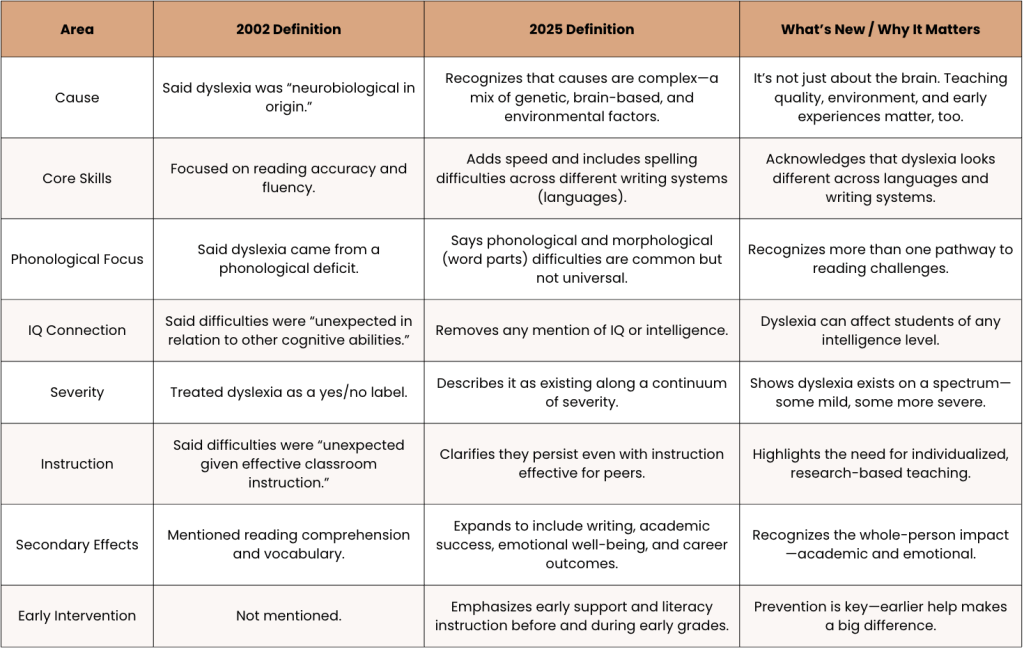
What Has Changed?
Here’s a quick look at what’s different and why it matters.
What This Means for Teachers
- Watch for persistence – Struggles that continue despite “good instruction” may be signs of dyslexia. Early screening and support are essential.
- Use evidence-based instruction – Structured literacy approaches that explicitly teach phonics, morphology, and vocabulary work best.
- Address the whole child – Dyslexia isn’t just about reading—it can affect confidence and motivation.
- Advocate for early screening – Identifying students early leads to better outcomes later.
What This Means for Parents
- Dyslexia is real and not your child’s fault – The new definition reinforces that these struggles come from how the brain and environment interact, not lack of effort.
- Early help works – Don’t wait for a diagnosis if you notice difficulties—ask about screening and support.
- Support emotional well-being – Confidence and self-esteem are just as important as reading skills.
- You are not alone – Dyslexia is common, and with the right support, kids can thrive.
What This Means for Students
- You’re not “bad at reading.” – Your brain just learns differently, and that’s okay.
- Don’t give up – The right teaching helps your brain make strong reading connections.
- Ask for help early – Early support can make reading and writing much easier.
- You have strengths – Many people with dyslexia are creative thinkers, problem-solvers, and leaders.
To Sum it Up
The new definition moves away from the idea that dyslexia is caused by a single “deficit.” It now reflects what science (and teachers) already know:
Dyslexia is complex, exists on a continuum, and can be supported through early, evidence-based teaching that nurtures both reading and confidence.
The new definition doesn’t suggest a “one size fits all” approach. Dyslexia looks different for every person, which means effective support must be tailored to each learner’s unique strengths and needs. It is with hope that this updated definition brings us closer to what every family and educator wants—understanding, early support, and equity in literacy learning.
What are your thoughts? Will this new definition change how students with dyslexia are identified and supported in schools? How might it influence accommodations, interventions, and the way teachers approach literacy instruction?
Click here to follow us on Facebook!
Source:
International Dyslexia Association (2025). “IDA Definition of Dyslexia.” Presented at the IDA Annual Conference. https://drive.google.com/file/d/1lzQZTvJj9XIG08tN1C2sikBBmQ2TwJze/view
 Literacy for Justice
Leave a comment